
On this page
What a new gutter system includes
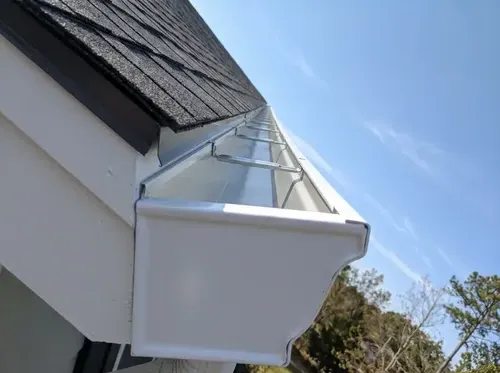
A full installation is more than the trough. It covers every part that moves water from the roof edge to the ground:
| Part | What it does | What to ask for in Madison |
|---|---|---|
| Drip edge | Metal flashing that sends water off the shingles into the gutter | Check it is there; many older isthmus houses have none |
| Gutter | The trough, 5-inch or 6-inch K-style, or half-round | Coil thickness of at least .027 inch aluminum; .032 on long or high runs |
| Hangers | Brackets that hold the gutter to the fascia | Screwed hidden hangers, spaced closer than the default |
| Corners and end caps | The only joints in a seamless run | Mitered, riveted and sealed in warm, dry weather |
| Outlets | Where the gutter drops into a downspout | Sized to the downspout, placed below valleys |
| Downspouts | Vertical pipes to the ground | 2x3 or 3x4, strapped at every joint |
| Elbows and extensions | Turn the water away from the house | Long enough to clear the basement backfill |
How the job runs
- Measure and look. The contractor measures each run, checks the pitch of the fascia, probes for soft wood and looks at where water goes once it reaches the ground. In winter they also look for ice-dam staining on the soffit and ceilings.
- Write the contract. Under Wisconsin's ATCP 110 home improvement rules, the contract has to be written whenever you pay before the job is done. It must describe the work and main materials, give the total price and the start and finish dates, and include any warranty.
- Strip and repair. Old gutters come down, nails and spikes are pulled, and rotten fascia or soffit is replaced.
- Form and hang. A machine on the truck rolls each run from a coil of aluminum. The crew snaps a line for pitch, usually about a quarter inch for every 10 feet toward the outlet, and screws in the hangers.
- Seal and test. Corners and end caps are sealed, downspouts strapped, and water run through every section before the crew leaves.
Why Madison installations are different
Ice and snow load. Madison averages 51.8 inches of snow a year. Snow sliding off a steep upper roof can hit a lower gutter with real force, and ice that builds in a trough during a cold snap weighs far more than any leaves. Gutters hung on widely spaced spikes are the ones found hanging off the house in March.
Freeze and thaw. About 17 mornings a year reach zero or below, and many more swing above and below freezing in a day. That movement works sealant loose at corners, so the quality of the joints matters more than the color of the metal.
Summer rain. June is the wettest month at the airport, with 5.28 inches in a normal year. Long rooflines feeding one downspout overflow in a thunderstorm even when they cope in light rain.
Basements. Most houses here have one. Every downspout needs to land well away from the wall; the Wisconsin DNR rain garden standard uses 10 feet from a full-basement foundation as the minimum for soaking water into the ground.
Choosing the size and style
| House | Common choice | Why |
|---|---|---|
| 1950s ranch in Hill Farms or Westmorland | 5-inch K-style, 2x3 or 3x4 downspouts | Low roofs, modest planes |
| Two-story in Middleton, Fitchburg or Sun Prairie | 6-inch K-style, 3x4 downspouts | Large, steep roofs with valleys |
| Bungalow in Marquette or Tenney-Lapham | 5-inch or 6-inch half-round, round downspouts | Matches the period |
| Period Revival house in Nakoma or University Heights | Copper half-round | Lasts with the slate or tile roof |
| Mansion Hill house with built-in gutters | Relined box gutter | Keeps the original cornice |
See seamless gutters, aluminum gutters, 6-inch gutters, half-round gutters, copper gutters and downspouts.
When to schedule
Late spring to early fall is the best window. Silver and red maples drop their seeds in late spring; once that is over and the ground is dry, crews can set ladders safely and sealant cures well. October and November fill up with cleaning and guard work before the first hard freeze. If your gutters are failing in winter, a contractor can usually secure loose runs and clear downspouts, and schedule the full job for spring.
How to check a gutter contractor in Wisconsin
Wisconsin has no license that is specific to gutter work. What it does have is a set of home improvement rules, ATCP 110, enforced by the Department of Agriculture, Trade and Consumer Protection. They require a written contract whenever you pay anything before the job is finished, or whenever the contractor came to you first, by knocking, calling or leaving a flyer. The contract has to name the seller and their address, describe the work and the main materials, give the total price and the start and finish dates, and include any warranty.
If a job does need a building permit on a one- or two-family home, the person pulling it must hold a state Dwelling Contractor certification, which comes with proof of insurance. Most gutter jobs need no permit, so ask for the certificate of insurance anyway, sent by the insurer.
Before you sign, the contractor must tell you in writing that you can ask for lien waivers from every subcontractor and supplier. If the sale started at your door, you usually have a three-day right to cancel once you have the written notice. Questions go to the Consumer Protection hotline at 1-800-422-7128.
Questions to ask before you sign
- What size and coil thickness are quoted, and why?
- What hangers, at what spacing?
- Where will each downspout go, and how far will it discharge?
- Is drip edge included where missing?
- How is fascia repair priced?
- What are the start and completion dates?
- What warranty is in the written contract?
Installation and your roof
If you are planning a new roof in the next few years, consider doing gutters at the same time or right after. The roofer installs drip edge and ice and water barrier at the eaves, and new gutters fit to that. Gutters installed first can be damaged when the roof comes off.