
On this page
Where half-round fits
Half-round gutters were standard on houses built before the Second World War. Madison has a lot of them:
| Area | Houses | Source |
|---|---|---|
| Mansion Hill | Italianate and Queen Anne houses, 1850s to 1910 | Wikipedia |
| Marquette | Worker cottages, Queen Anne houses and the Marquette Bungalows | Wikipedia |
| Tenney-Lapham | Queen Anne, Shingle style and bungalows on Sherman Avenue | Wikipedia |
| Vilas | Foursquares and bungalows in the Wingra Park district | Wikipedia |
| University Heights | Queen Anne, Shingle style, Prairie and Revival houses, 1894 on | Wikipedia |
| Nakoma | Period Revival houses, 1915 to 1946 | Wisconsin Historical Society |
Aluminum, steel or copper
- Aluminum half-round is the most common and least expensive, in black, white, bronze and other colors.
- Galvanized or Galvalume steel is stiffer and takes ice well, but needs care to avoid rust at cuts and scratches.
- Copper suits stone and brick houses with slate or tile roofs and lasts for decades. See copper gutters.
Brackets and snow
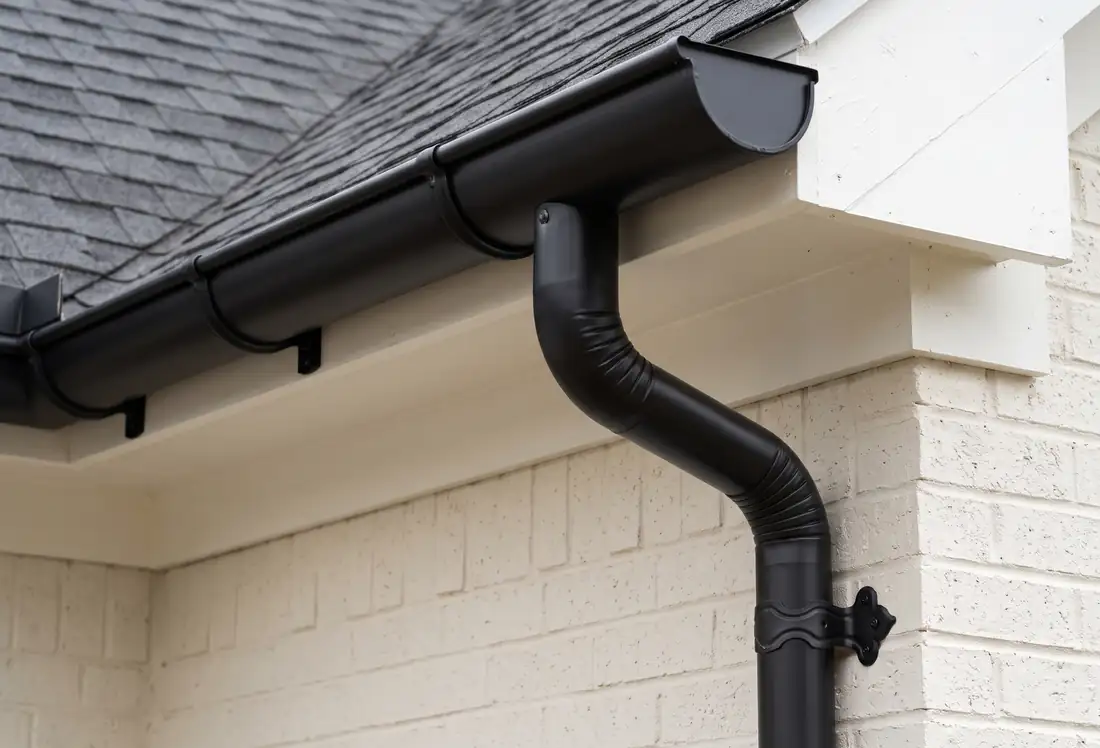
Half-round hangs on brackets, either screwed to the fascia or strapped to the roof deck under the shingles. Exposed brackets look right on period houses. For Madison snow, ask for brackets every 24 inches or closer, heavier brackets below valleys, and brackets fixed into sound wood. Roof-mounted straps work where there is no fascia, but they have to go in with a roof job or with care under the shingles.
Size
On a bungalow with a low roof, 5-inch half-round may be plenty. On a tall Queen Anne house with a steep roof and several valleys, 6-inch half-round with 3- or 4-inch round downspouts is the usual choice. Downspouts can be smooth or corrugated; corrugated round downspouts flex a little when ice forms inside.
Historic districts
Madison's local historic districts include Mansion Hill, Third Lake Ridge, University Heights, Marquette Bungalows and First Settlement, and the Landmarks Commission reviews exterior alterations there. Check with the city before changing gutter type, removing built-in gutters, or altering a cornice.
Common mistakes to avoid
- Using 5-inch half-round on a tall, steep roof that needs 6-inch capacity.
- Spacing brackets too far apart for snow.
- Mixing copper brackets with aluminum gutters, or the reverse.
- Changing gutter type in a local historic district without checking with the city.
Half-round hardware
| Part | Options |
|---|---|
| Brackets | Fascia-mounted, roof-strap, decorative cast |
| Outlets | Drop outlets sized to 3-inch or 4-inch round downspouts |
| Downspouts | Smooth or corrugated round |
| Elbows | Round, in matching metal |
| End caps | Plain or decorative |
Corrugated round downspouts are often used in cold climates because the ridges let them flex a little when ice forms inside.
Cost
Half-round usually costs more than K-style of the same size, because of the brackets and the specialist forming or sections. Copper half-round costs several times more; national guides put copper at about $30 to $50 a foot.
Keeping a bungalow's look
On Craftsman bungalows, like those in the Marquette Bungalows district, the deep eaves and exposed rafter tails are part of the design. Half-round on simple brackets, in a dark color or one that matches the trim, sits quietly under those eaves. Where rafter tails are exposed and there is no continuous fascia, roof-strap brackets may be the only way to hang the gutter.
Related
See copper gutters, gutter replacement and aluminum vs steel vs copper.