
On this page
Sizes and where they go
| Downspout | Capacity | Use |
|---|---|---|
| 2x3 inch | Standard | One-story houses, short runs, 5-inch gutters |
| 3x4 inch | About twice a 2x3 | 6-inch gutters, two-story roofs, valleys, long runs |
| 3-inch or 4-inch round | Similar to 2x3 and 3x4 | Half-round gutters on older houses |
Downspouts belong at the low end of each run, below valleys, and at corners where two runs meet. Long runs usually get one at each end with the gutter pitched both ways from the middle.
Getting water away from the basement
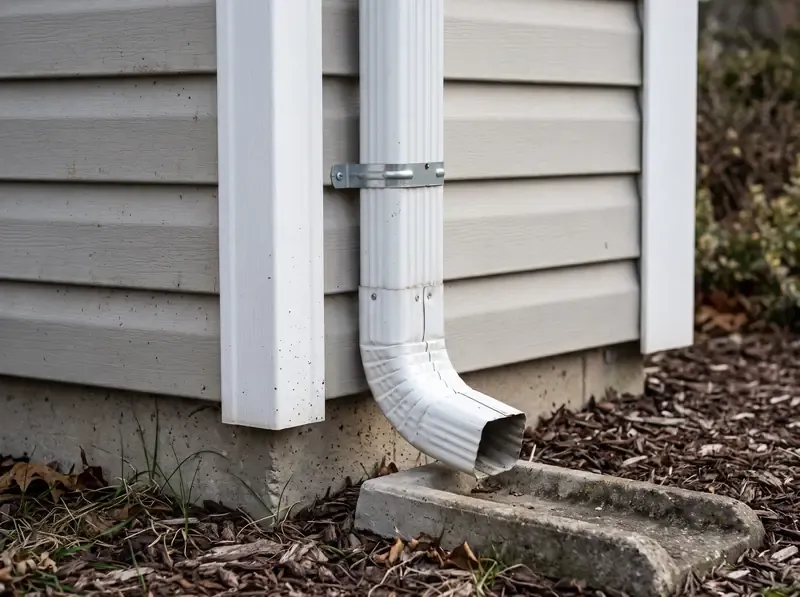
Most Madison houses have a basement, and the soil around it was dug out and backfilled when the house was built. That backfill takes water easily. A downspout that empties onto a splash block at the wall sends water straight down beside the foundation.
What works:
- Extensions long enough to clear the backfill and land on ground that slopes away.
- Splash blocks set with the open end downhill, and checked each spring.
- Buried solid pipe to a pop-up emitter or daylight outlet in the yard.
- A rain garden. The Wisconsin DNR's standard sets a minimum 10-foot setback from a full-basement foundation and 5 feet from a frost footing or pavement.
The City of Madison's Engineering Division notes that many homes in high-groundwater areas depend on sump pumps. Every gallon a downspout puts at the foundation is one more the sump has to lift back out.
Winter
Downspouts are where Madison gutters freeze first. Meltwater from a sunny roof runs in during the afternoon and freezes in the elbow after dark. Over a few days the pipe fills with ice, and the gutter above backs up and overflows, adding to the ice on the eave.
- Bigger downspouts take longer to fill.
- Downspouts on south and west walls thaw sooner.
- A clear outlet and a gentle extension, not a long flat run on the ground, help water leave before it freezes.
- Fixing the attic heat leak reduces the meltwater in the first place. See ice dams and gutters.
Walks and driveways
Water that crosses a walk at night is ice by morning. Route downspouts away from steps, walks and driveways where the yard allows, or take them under the paving in a pipe. On commercial property this matters even more; see commercial gutters.
Old buried pipes
Older houses sometimes have downspouts running into clay tile or cast-iron pipes that go somewhere nobody remembers. Some are blocked, some are broken under the yard, and a few may connect where they should not. Ask the contractor to run a hose into any buried line before connecting a new downspout to it.
Common mistakes to avoid
- Leaving extensions off after mowing season, so March meltwater drains at the wall.
- Running a long flat extension on cold ground, where it freezes first.
- Connecting to an old buried pipe without testing where it goes.
- Discharging onto a neighbor's lot or across a public sidewalk.
Downspout placement checklist
- One at the low end of each run, and one at each end of very long runs.
- One below every valley that dumps into a gutter.
- None emptying onto walks, steps or the driveway.
- None aimed at a neighbor's lot.
- Each extension clears the basement backfill and lands on ground sloping away.
- Each joint strapped to the wall.
- Each outlet sized to the downspout.
Extensions compared
| Extension | Pros | Cons |
|---|---|---|
| Fixed aluminum | Cheap, effective | Gets knocked off by mowers |
| Hinged flip-up | Lifts for mowing | Must be put back down |
| Roll-out sleeve | Unrolls in rain | Freezes, tears |
| Buried pipe to pop-up | Out of sight | Can freeze or silt up |
| Rain garden | Soaks water in | Needs space and setback |
The Wisconsin DNR standard keeps rain gardens at least 10 feet from a full-basement foundation.
In the City of Madison
All parcels in the city pay a stormwater fee. City Engineering advises on sump pump discharge if you contact them before installation. Tying a downspout into a public storm sewer needs approval; ask first.
Related
See downspout repair, downspouts, sump pumps and wet basements and stormwater in Madison.