
On this page
Where copper belongs
Copper makes most sense on houses that will be kept for decades and whose roofs are slate, tile or quality cedar. In Madison that includes:
- Mansion Hill, where several notable houses are built of local sandstone, among them the Fox/Van Slyke and Bashford houses from the 1850s.
- Nakoma, which the Wisconsin Historical Society describes as having some of the city's finest Period Revival residences.
- University Heights, with Prairie School houses by Frank Lloyd Wright, Louis Sullivan and George Maher among its 397 contributing buildings.
- Lakeshore houses in Maple Bluff and Shorewood Hills.
What copper costs
National guides put installed copper gutters at about $30 to $50 a foot, against roughly $9 to $13 for 5-inch aluminum. Soldered corners, conductor heads, round downspouts and custom box gutters push the price up further.
How it weathers
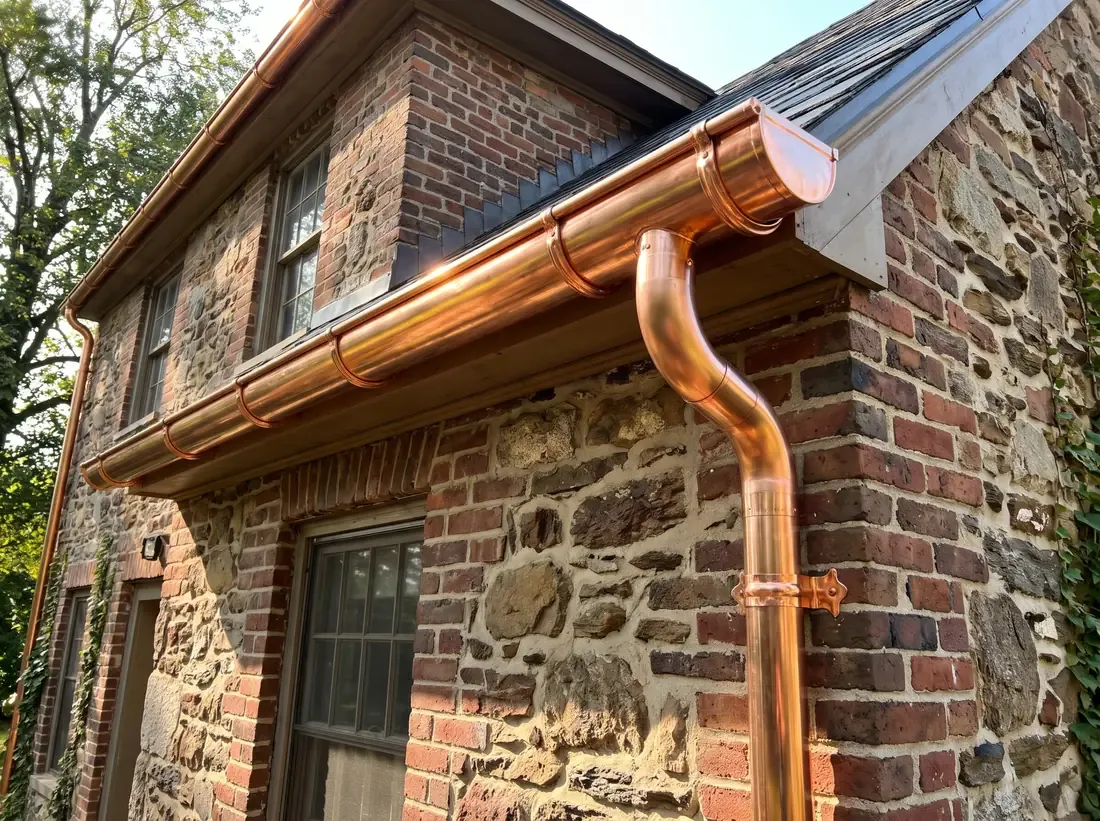
New copper is bright. Within months it dulls to brown, and over years it moves toward the familiar green-blue patina. Runoff carries traces of copper and can stain light stone, stucco or concrete below. Downspouts should empty onto ground or into drains, not across limestone steps.
Built-in copper gutters
Some older Madison houses and churches have gutters built into the cornice and lined with copper or terne metal. When the lining fails, water goes into the wall, often appearing as a stain inside the house rather than a drip outside. Relining in copper keeps the original look. It is specialist work; ask for photos of past box gutter jobs.
Copper and winter
Copper's soldered seams and stiffness help in winter. Close bracket spacing still matters, and so does fixing the attic heat loss that causes ice dams. A heavy copper gutter full of ice is still a heavy load on the fascia.
Copper with other metals
Copper reacts with aluminum and galvanized steel where they touch in water. Fasteners, brackets and flashing in contact with copper should be copper or stainless steel.
Historic review
In Madison's local historic districts, replacing copper with aluminum, or changing the gutter type, may need review by the Landmarks Commission. Replacing copper with copper is usually straightforward.
Common mistakes to avoid
- Relying on sealant rather than soldered seams.
- Using galvanized or aluminum fasteners that react with copper.
- Discharging copper downspouts across limestone or light concrete, which stains.
- Leaving copper downspouts at ground level where they invite scrap theft.
Copper weights and gauges
Copper gutters are specified by weight per square foot, commonly 16 ounce or 20 ounce. Heavier copper is stiffer and better on long or exposed runs and under sliding snow. Ask which weight is quoted, and whether brackets, straps and fasteners are copper or stainless.
Copper and Madison winters
| Concern | What helps |
|---|---|
| Ice load | Soldered seams, close bracket spacing, heavier copper |
| Sliding snow | Snow guards above, strong brackets |
| Ice dams | Attic air sealing and insulation |
| Staining | Downspouts onto ground or drains, not across stone |
Living with patina
Some owners like the bright new look and treat copper to slow weathering. Most let it age naturally. Either way, the metal keeps working long after the color changes.