
On this page
Common downspout problems in Madison
| Problem | Cause | Repair |
|---|---|---|
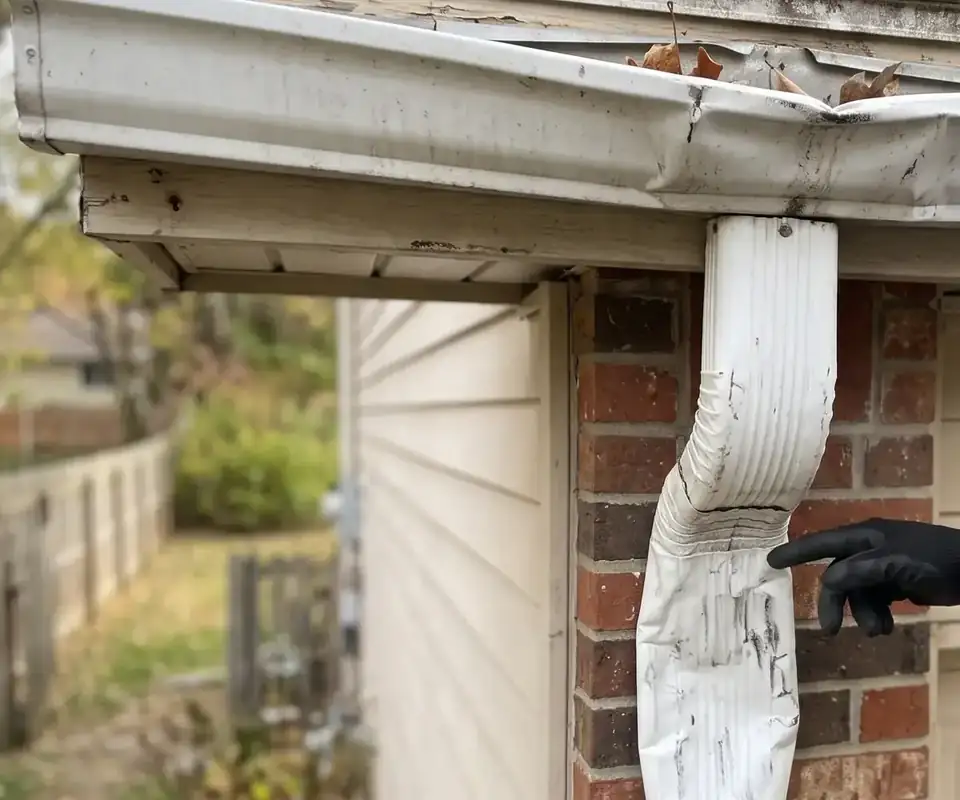
| Split seam or bulge | Ice inside the pipe | Replace the section, often with 3x4 |
| Crushed bottom | Snowblower, mower, car | Replace the elbow and bottom length |
| Pulled off the wall | Missing or loose straps; ice weight | Re-strap at every joint |
| Detached from the outlet | Ice push, poor connection | Re-fit and screw the joint |
| Water at the foundation | No extension, or extension removed | Add a hinged or buried extension |
| Clogged | Maple seeds, leaf bits, ice | Clear and flush; guard the outlet |
| Ice sheet on walk | Discharging across paving | Reroute or pipe under the walk |
Frozen and split downspouts
A downspout freezes from the bottom up. Water trickles in during a sunny afternoon and freezes in the elbow overnight; each day adds a layer. Eventually the pipe is solid, the gutter above backs up, and the expanding ice splits the downspout seam. It is the single most common winter gutter repair in Madison.
Ways to reduce it:
- Go up a size. A 3x4 takes longer to fill with ice than a 2x3.
- Keep the outlet clear. Seeds and leaves in the bottom elbow give ice a head start.
- Shorten the flat run. A long extension lying flat on cold ground freezes first. A short, sloped extension or a buried pipe below the frost line is better.
- Fix the source. Most winter meltwater on a cold day comes from attic heat. See ice dams and gutters.
Getting the water away
A downspout's job is not finished at the ground. The City of Madison's Engineering Division describes basements that weep water at the floor joint in routine rain in high-groundwater areas. Adding roof water at the wall makes it worse.
Good practice:
- Discharge onto ground that slopes away from the house, past the backfilled zone.
- Keep rain gardens and infiltration at least 10 feet from a full basement.
- Do not discharge onto a neighbor's lot or across a public walk.
- Re-attach extensions after mowing season and before snow.
Buried downspout lines
Buried lines are tidy but can freeze, crack or fill with silt. A good installation uses solid pipe, slopes continuously, ends at a pop-up emitter or daylight outlet, and has a cleanout. An overflow fitting at the downspout lets water escape if the line is frozen, instead of backing up into the gutter. If an old buried line is suspected of being broken or blocked, run a hose into it and see where the water comes out.
Common mistakes to avoid
- Hammering on a frozen downspout to break the ice.
- Replacing a split 2x3 with another 2x3 where a 3x4 would freeze less.
- Fitting sections upside down so water sprays out of the joints.
- Leaving the bottom elbow full of seeds going into winter.
Downspout repair costs
Downspout repairs are among the cheapest gutter fixes: a new elbow, a section of pipe, straps and an extension. The bigger savings come from what they prevent. A split downspout that dumps water at the foundation through a March thaw can cost far more in basement cleanup than the downspout did.
A spring check
After the snow goes, walk around the house:
- Look for split seams and bulges at the bottom elbows.
- Check that every downspout is still strapped to the wall.
- Put extensions back on and check they point downhill.
- Reset splash blocks that have sunk or tipped.
- Run a hose into buried lines and watch for water at the outlet.
Downspouts and your neighbor
Water from your roof that runs onto a neighbor's lot is a common source of disputes. Keep discharge on your own property, directed toward the street, the back of the lot or a rain garden, and away from shared walks.
Related
See downspouts, downspouts, sump pumps and wet basements and stormwater in Madison.